Where the money actually lands.
The Australian market has three broad tiers. Freelance and micro-studios. Independent boutique studios. Large multi-discipline agencies. Each tier serves a different problem, at a different price point, with different trade-offs. Neither is right or wrong. They are calibrated to different jobs.
- Freelance and micro-studios. Typically $3,000 to $15,000 for a single-SKU pack, sometimes higher for range work. Best for founders with clear direction and simple ranges. Trade-off: strategic depth and retailer experience vary widely.
- Independent boutique studios (where Morice&Co. sits). $15,000 to $60,000 for a rebrand or range design. Senior craft on every project, direct founder-to-lead access, retailer-ready output. Trade-off: capacity is limited, briefs are selective.
- Large multi-discipline agencies. $60,000 upwards, often into six figures for full rebrand and system work. Best for enterprise clients with global rollouts. Trade-off: senior time is scarce, work often delivered by mid-level teams, fees carry overhead.
The variables that move price.
Number of SKUs. A single pack is one problem. A range of eight is ten problems, because the system has to hold as well as the individual designs. Beyond twelve SKUs, the range architecture becomes its own stage.
Whether the brand is included. Pure packaging refresh is one fee. Rebrand plus packaging is a different fee. The strategy and identity work takes weeks that pack design alone does not need.
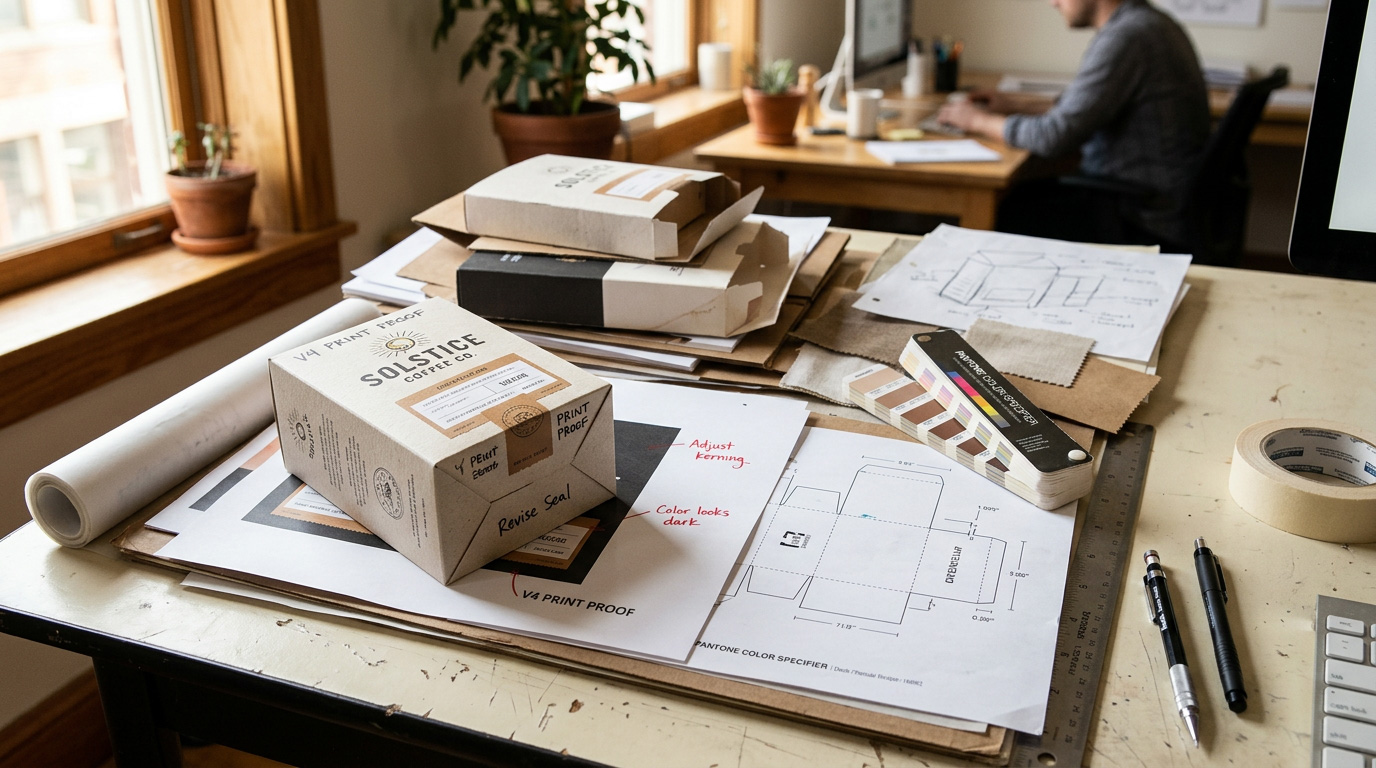
Whether finished art and production are included. Concept work ends when the design is signed off. Getting to the print floor requires dielines aligned to the printer, spot colour specs, varnish and foil callouts, regulatory copy compliance, and pre-press supervision. A pack signed off in concept is not a pack ready to print.
How many rounds of client review are budgeted. Two to three rounds is standard. Unlimited rounds is expensive. If nobody agrees the scope of feedback upfront, both sides discover it in month four.
What first-timers under-budget for.
- Photography and product renders. Often not included in packaging design fees. Budget separately.
- Regulatory and legal review. Nutrition panels, claims substantiation, allergen callouts. Not the designer's role but must be in the project timeline.
- Dielines and pre-press. The studio's job to prepare, but the printer's job to confirm. Small back-and-forth costs at the end of a project are normal.
- Print supervision. Attending press checks or reviewing physical proofs. Some studios include, some bill hourly.
- Multi-territory versions. If the pack ships to New Zealand, US, or UK, each market usually needs a variant.
The honest comparison.
At the freelance tier, you generally get a designer and a design. You bring the strategy, the retailer relationships, and the production wrangling. If you have those skills in-house, this works. If you do not, the cost saving at the design fee is spent twice over on missing the shelf.
At the boutique studio tier, you get strategy, design, and production-aware artwork with retailer experience baked in. You get the founder or creative director on every project, not a junior team behind the pitch. The fee reflects senior craft applied end-to-end. This is where most challenger brands and mid-market rebrands land.
At the large agency tier, you get scale, multi-discipline breadth, and global process. You also get overhead and a mixed team where senior talent is on other projects for most of yours. The economics work when the scope genuinely requires the scale.
The signal versus the noise.
The signal is who touches the work. If the person you brief is the person shipping the artwork, you are paying for craft. If there are three handovers between brief and pack, you are paying for coordination. Neither is wrong, but only one moves the needle on your shelf.
The second signal is what the studio can show you from their own retail past. Case studies on category leaders. Named brands from Coles, Woolworths, Chemist Warehouse, Priceline. Real receipts from the shelf you are trying to win. Awards are a proxy for craft. Retail history is a proxy for outcome.
The cheapest packaging design is expensive. The right packaging design pays for itself in the first six months of retail sell-through.
Fixed fee, scoped to the brief.
Every Morice&Co. project runs on fixed fee against a written brief. A detailed proposal within five working days of an initial conversation. Scope, timeline, deliverables and investment on one document. No hourly rates. No scope creep. If the brief changes mid-project, the change is priced separately and agreed before the work moves. It removes the friction that eats trust.
The fee reflects senior craft applied end-to-end. Morice leads every brief, every concept, every pack file. The people you meet in the first conversation are the people shipping the artwork four months later. That is where the fee lands.