The claim went everywhere at once.
Protein became the most commercially powerful nutrition claim in Australian grocery because shoppers decode it instantly. No education required, no explanation panel, no regulatory tightrope. Say twenty grams and the shopper knows what they are buying. That efficiency is exactly why the claim spread so fast, from sports nutrition into yoghurt, then into snacks, then into categories that had no business carrying it.
The result is a shelf where the claim has no discriminating power left. Protein bread sits beside protein cereal beside protein ice cream. In pet, high protein has become a baseline expectation rather than a reason to switch. A claim that everybody makes is not a claim. It is a category entry ticket, and entry tickets do not build brands.
This is the same arc the category watched with low fat, then with no added sugar, then with clean label. Each one delivered a genuine window of advantage. Each one closed when the fast followers arrived. Protein is now late in that cycle, and the brands still building their front of pack around it are optimising for a window that has already shut.
The number ate the brand.
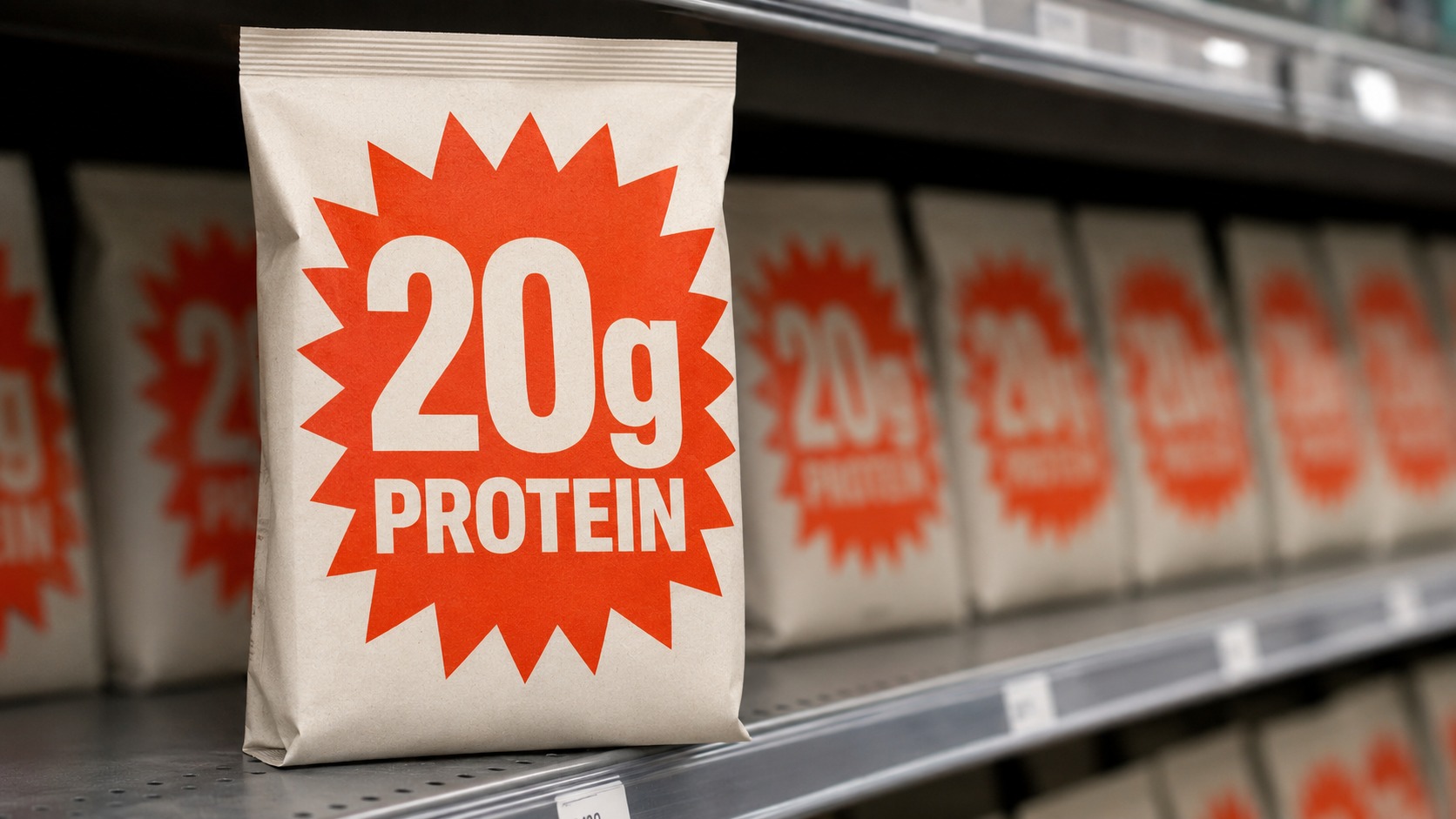
Watch what happens to a pack when protein becomes the lead message. The gram count gets a flash, a burst or a badge. The badge needs contrast, so it takes the strongest colour. The strongest colour was carrying the brand block, so the brand block shrinks. Six months later the pack is a number with a logo attached, and it looks like eleven other packs in the same bay.
The trade is worse than it looks on a screen. A shopper scanning a fixture reads shape, colour and brand asset before they read any text. When the claim consumes the assets that made the range findable, the pack loses the thing that drove repeat purchase in order to win an argument that every competitor is also winning. Distinctiveness gets spent to buy parity.
A claim everybody makes is not a claim. It is a category entry ticket, and entry tickets do not build brands.
Shoppers are already discounting the number.
Protein washing describes fortification with no functional logic behind it. Protein added to a product where the format cannot deliver a meaningful dose, or where nobody was asking for it. Shoppers work this out faster than brands expect, and the correction is not category-wide scepticism. It is worse than that. It is indifference. The claim stops being read at all.
There is a regulatory edge here too. Nutrition content claims carry compositional conditions, and a front of pack built around a number that the serve size barely supports is a fragile position to defend. The brands with a real formulation story have every reason to distance themselves from the ones borrowing the language. The way to do that is not a bigger number. It is proof, provenance and craft that the borrowers cannot copy in a quarter.
Demote the claim, promote the reason.
None of this argues for hiding protein. If the product genuinely delivers, the claim earns its place. It just does not earn the hero position. Put it where a shopper who is looking for it will find it in under a second, and give the hero position back to whatever makes the brand worth remembering. Source, process, taste, format, a point of view the category has not claimed.
- Photograph your fixture and count how many competitors lead with a protein figure.
- If the answer is more than three, the claim is no longer differentiating you.
- Identify which brand asset the claim has displaced, and give it back its space.
- Check the serve size actually supports the claim under the compositional conditions.
- Name the reason to choose you that has nothing to do with a gram count.
The last question is the one that matters. A brand that cannot answer it is trading on a claim it does not own and cannot defend. When the next fortification wave arrives, and it will, that brand has nothing left to stand on. The ones that used this cycle to build something proprietary will still be on shelf, still findable, still worth paying more for.